
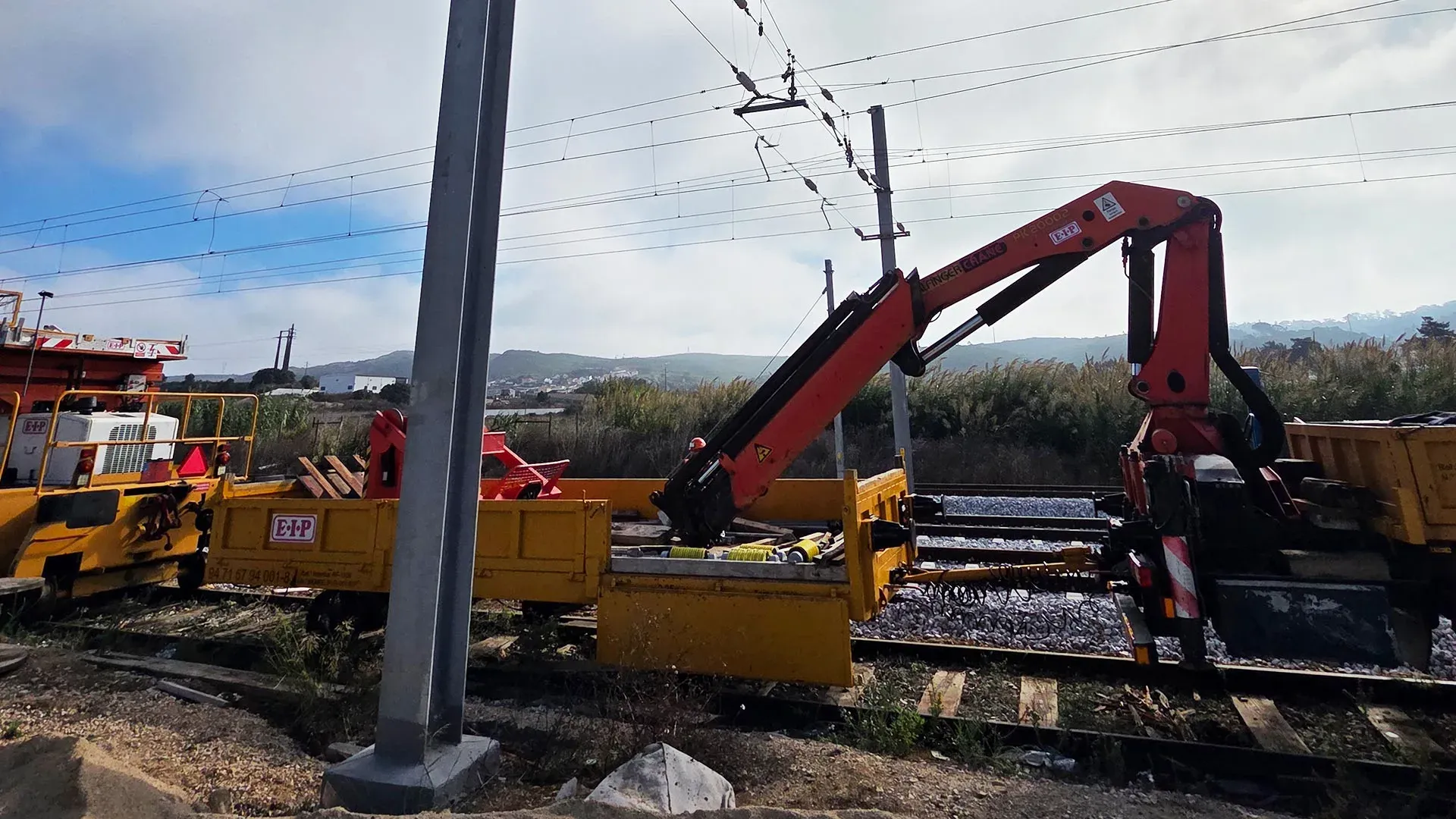

The objective of the test was not to simulate every possible condition, nor to deploy across a wide range of operating sites. Instead, it aimed to answer a practical, targeted question: can a technology originally designed for overhead power lines help detect cable theft and unauthorized disturbances in railways?
Background: A New Challenge for Line Monitoring
Railway systems in Europe are increasingly targeted by cable theft, particularly in catenary lines and traction energy infrastructure. These attacks cause costly damage and lead to service interruptions, safety risks, and expensive inspections.
Most thefts occur in remote areas, often at night, and are hard to detect in real time. Current inspection methods rely heavily on visual checks and scheduled patrols, which are expensive and reactive.
SENTRI, Sentrisense’s smart monitoring sensor, had already proven its effectiveness in overhead power line environments—detecting mechanical vibrations, identifying tilt and movement, and sending real-time alerts. The challenge was to adapt this same capability to monitor catenary cables and detect abnormal motion caused by potential theft attempts.
Objective of the Test
The testing with Infraestruturas de Portugal was designed to evaluate:
- The ability of SENTRI to be installed on a railway catenary system safely and quickly
- The mechanical stability and behavior of the sensor during controlled movement and vibration
- The performance of the digital communication system under real field conditions
- The ability of the SENTRI platform to detect and report disturbances in a reliable and timely way
- The potential for SENTRI to support theft detection and early warnings in rail environments
The test was conducted under non-operational conditions. There was no power flowing through the lines, and no trains were operating in the area during the trial. The aim was to evaluate the system and verify its core functions in a rail-specific setup.
Installation and Setup
The SENTRI unit was installed on a support cable and later on a contact wire using a standard grounding rod. The equipment’s mechanical clamp system held the device firmly in place, with no visible displacement or slack. The setup did not require special tools or invasive procedures, and the installation took under five minutes from start to finish.
This is particularly important in railway environments, where access is often limited and downtime is costly. Being able to deploy a monitoring unit quickly, without disrupting operations, makes SENTRI a viable tool for scheduled inspections and temporary deployments during maintenance windows.
Sensor Response to Movement and Vibration
Once installed, the SENTRI sensor was subjected to a series of controlled disturbances. Technicians applied vibration to the support cable and contact wire using manual rods to simulate mechanical tampering or theft-like behavior. The sensor consistently recorded these disturbances and transmitted motion data to the Sentrisense platform with minimal latency.
Vibrations above configured thresholds generated real-time alerts, which were clearly displayed in the platform’s dashboard. The system showed the ability to differentiate between minor, short-lived movements and stronger, sustained actions—exactly the type of behavior expected during a theft attempt.
In addition to vibration, the tilt sensor was tested by simulating changes in the sensor’s orientation. These tilt readings remained stable after installation and were unaffected by routine environmental shifts, indicating strong mechanical reliability. The sensor captured gradual shifts during movement and returned to baseline once stabilized, as expected.
Communication and Data Integrity
One of the key success metrics of the test was the consistency of data transmission. The SENTRI device communicated via a 4G mobile network, with data reaching the platform in intervals of about two minutes. No data packets were lost during the test, and the visualization on the dashboard remained stable and synchronized.
All alerts, battery status, signal strength, and environmental measurements were logged without delay. The platform allowed for CSV exports of historical data, which matched the values captured in real time—useful for audits, reporting, or integration into external SCADA systems.
The ability to maintain a stable connection in a semi-remote area speaks to the adaptability of SENTRI for railway contexts, which often suffer from communication blind spots.
Detecting Theft in Practice
All of this served to validate a key premise: that SENTRI can be adapted for theft detection in railway catenary systems.
By reacting to vibration and tilt, the system can recognize when a cable is being disturbed. When installed strategically across a stretch of rail line, SENTRI could act as a distributed alarm system, providing utilities and rail operators with actionable insights in near real-time.
The value of this approach lies in early detection. Rather than discovering a theft incident hours later during an inspection round, operators could be alerted within minutes of the cable being moved. This has the potential to not only reduce losses but also deter attackers once the system becomes known.
A Step Toward Broader Applications
Beyond theft detection, this test opens the door for more ambitious use cases in the rail sector:
- Monitoring mechanical fatigue in the catenary to prevent service disruptions
- Real-time alerts for accidental pole impacts or wire slack
- Load balancing insights across rail energy systems
- Integration with control centers for faster incident response
With SENTRI already deployed across multiple power grids worldwide, expanding into railways is a natural next step. The modular nature of the sensor and the flexibility of the platform make it adaptable to new contexts and challenges.
Partnership and Collaboration
The successful execution of this pilot was made possible through close coordination with Infraestruturas de Portugal, who provided technical feedback, test sites, and operational support.
Their team’s attention to detail, combined with Sentrisense’s engineering capabilities, allowed the project to run efficiently while staying focused on practical insights. While the deployment was limited in scale, the quality of the collaboration created a solid foundation for further exploration.
The Sentrisense team extends special thanks to all those involved in Portugal and abroad who supported the initiative.
Looking Ahead
The energy transition demands smarter infrastructure across power grids, transportation, and beyond. SENTRI was built to help utilities move from reactive maintenance to predictive, data-driven decision making. Now, that same intelligence is being tested in new domains where safety, efficiency, and security are just as vital.
This test in Portugal was a first step. The next phases will include broader field validation, integration into operating rail systems, and expanding partnerships with public and private rail operators.
As always, Sentrisense will continue to innovate where it matters most: on the line.
👉 Learn more at sentrisense.com
